Welcome to the blog for the Villanova English department! Visit often for updates on department events, guest speakers, faculty and student accomplishments, and reviews and musings from professors and undergraduates alike.

Showing posts with label faculty. Show all posts

Monday, June 22, 2026

Kamran Javadizadeh on Phatic Language, ‘the master’s tools,’ and More

image retrieved from 
events.stanford.edu
Dr. Kamran Javadizadeh traveled to California this past spring to give talks on the poets Jack Spicer and Solmaz Sharif. We sat down with Dr. Javadizadeh recently to hear more about these talks, which covered subjects as diverse as poets as radios, the notion of AI poetry, assimilation and language, and Iranian immigrant experience in the US.

We first discussed Dr. Javadizadeh’s lecture at the Stanford Center for Poetics, which describes itself as “a home for research in poetics across periods, languages, and methods.” His talk, which took place on April 23rd, was titled "Making Contact: Jack Spicer and Phatic Poetics." Dr. Javadizadeh borrows the concept of “phatic language” from the Russian linguist Roman Jakobson, a concept which Dr. Javadizadeh describes as a variety of language in which “you’re not communicating, so much as you’re calling attention to the channel along which you are about to be communicating.” Some examples might include small talk (“When you see someone, you say, ‘hey, how you doing?’ You're not really asking them how they're doing”), or stepping up to a microphone and saying ‘Is this thing on?’”

Although phatic communication was not an idea that Jakobson associated with poetry, Dr. Javadizadeh stated that he has a “kind of perverse, but counterintuitive, maybe, idea” that the phatic function of language is an important facet of poetry, and he has tried to “give different versions of it using different poets as examples.” Dr. Javadizadeh felt it would be interesting to use the poet Jack Spicer at Stanford in part because he was a Bay Area poet, but also because he was himself “quite interested in linguistics” and had some “bizarre ideas about poetry” (although Dr. Javadizadeh noted that it’s hard to know quite how seriously to take everything Spicer wrote about poetry).

“Spicer came to think,” said Dr. Javadizadeh, “that, poetry was, not something that came from inside of him, but that it was something that came from the outside, sort of through him, that poetry was dictated to him. Sometimes he described it as Martians using him to create poetry… Sometimes he compared poets to radios that receive transmissions.”

Dr. Javadizadeh went on to state that another reason he felt Spicer and the phatic function of language would be interesting to talk about in the Bay Area was that it provides “a kind of answer to what it is that we might object to--without knowing why we're objecting to it--when the topic of AI-generated poetry comes up.”

“I'm willing to stipulate,” said Dr. Javadizadeh, “that an AI could produce a better poem than what I've seen so far, but I think I still wouldn't care very much about it,” because the phatic function would be missing—in other words, the sense that “somebody’s on the other end of the line.”

Therefore, Dr. Javadizadeh chose “Making Contact” as a title for this talk: “The idea that what poetry might be making is not the artifact that is the poem, but the contact itself--that is, the connection between the poet and the reader as the real thing that's being made by poetry--is an interesting idea to me.”

In addition to his talk on Jack Spicer, Dr. Javadizadeh also participated in a so-called “sushi salon” (a lunchtime talk) with Stanford students taking part in that university’s Structured Liberal Education program. Dr. Javadizadeh was in conversation with Dr. Elias Kleinbock, who, inspired in part by Dr. Javadizadeh’s podcast, Close Readings, chose to center their talk around one poem—in this case, Solmaz Sharif’s “The Master’s House.”

Dr. Javadizadeh noted that he had wanted to choose something contemporary, and that Sharif is one of his favorite contemporary poets (you can read his review of Sharif’s collection Customs in The New York Review of Books). In addition, with the talk taking place in the early days of the American and Israeli bombing of Iran, Dr. Javadizadeh felt the poem would provide a way to “bring some attention to Iran in ways that are not what people were typically hearing or reading about in the early stages of this war, at the time.”

The poem’s title quotes a famous line from Audre Lorde (“The master’s tools will never dismantle the master’s house”).

“So what,” said Dr. Javadizadeh, “does Sharif mean by ‘the master’s house’ here? Maybe the United States, or maybe it’s English—as a language, an academic discipline, a poetic tradition… There’s this very touching moment at the end of the poem where, she seems to be sharing a memory about her father, who had a shotgun held to his chest by a Texan.”

Sharif writes:

To recall the Texan that held the shotgun to your father’s chest, sending him falling backward, pleading, and the words came to him in Farsi

To be jealous of this, his most desperate language

To lament the fact of your lamentations in English, English being your first defeat

Dr. Javadizadeh discussed those lines in length at Stanford, analyzing how, “for people who are in any measure bilingual or polylingual, there might come the question, alright, if you’re suddenly in a desperate situation… what language comes to your lips? And for Sharif’s father, it’s Farsi, or Persian. But for Sharif, clearly it’s English.”

According to Dr. Javadizadeh, “In a sort of typical kind of immigrant narrative,” Sharif’s default use of English might feel like assimilation or achievement, but in her poem she describes it as a defeat, as if “English has mastered her,” or she has, “in some sense, been colonized by it. And she can’t help but speak it.”

Dr. Javadizadeh described this as “a position that I identify pretty strongly with, as somebody whose first language was Persian, but I’ve made my whole life out of English.”

Overall, Dr. Javadizadeh noted that he had a wonderful time and received a warm reception at Stanford. Interested readers of this blog can read Solmaz Sharif’s “The Master’s House” in full on the Poetry Foundation’s website, and you can hear more reflections on poems from Dr. Javadizadeh on his podcast.

Wednesday, June 10, 2026

Emily Skillings Awarded Howard Foundation Fellowship

Emily Skillings
Our newest faculty member, Emily Skillings, who will begin teaching with us this fall, was just awarded a Howard Foundation Fellowship by the George A. and Eliza Gardner Howard Foundation.

The Foundation awarded 14 fellowships totaling $560,000 to support early mid-career individuals. Each recipient received an unrestricted $40,000 fellowship. The funds provide time to advance independent creative and scholarly work on a major project.

Per the George A. and Eliza Gardner Howard Foundation, "Since 1954, over 500 Howard Fellows have used the fellowship to transition from promising early-career status to recognized leaders in their fields. Howard Fellows have authored bestsellers, directed Oscar nominated feature-length films, and earned some of the world’s most prestigious honors including Pulitzer Prizes, the Rome Prize, and the Whiting Award. They have gone on to MacArthur, Guggenheim, and Carnegie Fellowships.

"The Howard Foundation carefully selects its Fellows through a rigorous and competitive multi-round process. This year’s Fellows stood out among a competitive candidate pool of 258 applicants, across 41 states and the District of Columbia."

Emily Skillings was awarded her fellowship in the field of poetry, for a project titled Of Pearl.

Per Skillings's biography for the fellowship, "Emily Skillings is the author of the poetry collections Fort Not (2017) and Tantrums in Air (2025), both published by The Song Cave. Tantrums in Air was named one of the best poetry books of 2025 by The New York Times. Skillings is the editor of Parallel Movement of the Hands: Five Unfinished Longer Works by John Ashbery, which was published by Ecco/HarperCollins in 2021. She is a member of the Belladonna* Collaborative, a feminist poetry collective, small press, and event series. Her work has been supported by residencies and fellowships from the T.S. Eliot Foundation and the New York Foundation for the Arts."

We look forward to welcoming Emily to Villanova this fall!

For more information about Emily Skillings and the Howard Foundation Fellowship, visit the Foundation's website.

Thursday, April 9, 2026

Catching up with Lauren Shohet

Dr. Lauren Shohet has been crisscrossing the country lately presenting on Shakespeare, Milton, AI, and more, so we thought it would be a good time to catch up with her and discuss her teaching and scholarship.

To begin with, Dr. Shohet gave a lecture at the Huntington Library on January 31st on “(In)Visibility and Mediation: Milton’s Eve,” in which she also discussed vanitas paintings (more on this later). Then, in February, she attended the Renaissance Society of America conference in San Francisco, where she gave a talk as part of the book history discussion group. In addition, while in San Francisco, Dr. Shohet also presided over Milton Society events. Finally, in early April, she attended the Shakespeare Association Conference in Denver and presented on Shakespeare and AI.

Regarding mediation and Milton’s Eve, Dr. Shohet explained that she is in the middle of a long project that examines mediation in Paradise Lost--as she put it, “What it is for angels and for the Son of God, to be mediators between God the Father and humans” Dr. Shohet explained that she is interested in communication as a form of mediation, in how any kind of communication is a kind of translation, and how to “get an idea from one mind to another mind.”

“So, my claim,” said Dr. Shohet, “is that mediation is inherent to the creaturely condition, whether you're looking before or after a fall, and that the importance of mediation makes us think differently about Eve's association throughout the epic with mediation. So we're, I think, more accustomed to seeing the ways that Adam's more direct access to God and to knowledge and to language diminishes Eve—which I think is true. But I also think that the epic shows that mediation is essential for being a creature in relationship—also of the most exalted kinds of relationship with the divine, with the world, with other people—and that Eve's expertise in mediation makes her an admirable and useful resource.”

Regarding the Renaissance vanitas paintings, Dr. Shohet explained that she is interested in a passage in Paradise Lost in which Eve examines her reflection in a pool and notes that the pool “to me seemd another Skie.” Although traditionally viewed as an instance of Eve looking for Heaven in the wrong place, Dr. Shohet is more interested in the idea that “When she says that the pool, to me, seemed another sky, she's aware of the fact that she's perceiving, and that her perception might not be the only perception, or might not be complete.”

Dr. Shohet then noticed that the image of Eve looking into the pool recalls a 17th century tradition of vanitas paintings, in which ephemeral things (like hourglasses and bubbles, but also scientific instruments and books) are contrasted with the divine and eternal (usually a skull is also present to remind us of our own mortality). “So I started thinking,” noted Dr. Shohet, “about how Eve looking in the pool reminded me of a lot of these vanitas paintings, some of which are by women artists, many of which do feature women. Because the viewer who's worried about Eve maybe being vain or narcissistic, or not understanding quite where to look for heaven, detects a little skull in that pool, detects mortality in that gaze.”

During her next trip, to the Renaissance Society of America conference in San Francisco, Dr. Shohet spoke about Paradise Lost and network theory, which she finds to be “a really intriguing way to think about medium.” As Dr. Shohet explained it, “Instead of thinking about signs and signifieds, or thing and word, I'm interested in these reciprocal, distributed ways that meanings are created by unpredictable constellations of different entities. And those entities can be matter, they can be word, they can be interpretive protocols, they can be allusion.” With regard to Paradise Lost, Dr. Shohet discussed network theory in relation to figurative language, “as something that pulls together all kinds of different frames of reference, and then, what guidance does the reader get in thinking about how to make meaning out of it?”

Finally, at the Shakespeare Association Conference in Denver, Dr. Shohet presented on Shakespeare and AI in the context of Othello. Her presentation focused on the way search algorithms and large language models depend on our input to make meaning; as Dr. Shohet put it, “What AI does is predict the statistically likeliest next word.” Meanwhile, “In the play Othello, the vice figure Iago manages to completely mess with the protagonist Othello's sense of who he is, who other people are, how he knows what's true, and what meaning is, by just repeating little bits of his speech back to him… If you ever had someone just repeat the last word of every sentence you speak back to you with a question mark, it's really unsettling… So, my paper's about ways you can ask students to use the play as a usefully unfamiliar context where they can evaluate how search algorithms and social media feeds draw on what they think should come next to manipulate them. And then, on the other hand, how they can use their own experience of, say, social media feeds, to get deeper inside the operations of the play.”

At the end of our interview, I asked Dr. Shohet for her general thoughts about AI.

“I am worried about AI,” she said, “…AND I think it's a really great opportunity to denaturalize our fantasies that we had non-iterative ways of knowing things before. You know, knowledge is always constructed, and it's constructed iteratively through feedback you get on performing a hypothesis, and then you perform it again. Just watching AI do that lets us say, ‘oh, that's how gender's constructed.’ That's how, right? You experiment with something, you reiterate it, you try it again. And that, conversely, becoming critical consumers of how that works in one arena can carry over to the other, and we can just ask more questions, both with and without AI.”

Vanitas by Antonio de Pereda

Tuesday, February 24, 2026

Tsering Wangmo at the Brooklyn Museum

Dr. Tsering Wangmo braved the weather this past weekend in order to facilitate a packed poetry workshop at the Brooklyn Museum in New York City. Professor Wangmo's workshop was part of a series, titled "I See You Face to Face," named in honor of Walt Whitman's "Crossing Brooklyn Ferry," referencing that Whitman once worked at the Brooklyn Apprentices' Library, which ultimately became the Brooklyn Museum. The series of workshops takes place in art galleries within the museum, allowing poets to draw from the art they see around them in crafting their verse. 

Dr. Wangmo's workshop took place in the Rubin Museum Tibetan Buddhist Shrine Room. According to the Brooklyn Museum's website, "The Rubin Museum Tibetan Buddhist Shrine Room presents more than 100 artworks and ritual objects as they would be displayed in an elaborate Tibetan Buddhist household shrine—a space used for devotional prayer, offerings, and rituals. Scroll paintings (thangkas), sculptures, ritual implements, and musical instruments dating from the 12th to 21st century are arranged on traditional Tibetan furniture according to their use in Tibetan Buddhist practices... The design incorporates elements of Tibetan architecture and the color schemes of traditional Tibetan homes, offering visitors the opportunity to experience Tibetan religious art in its cultural context." The workshop began with an overview of the space and its art, before transitioning into an opportunity to write poetry inspired by the surroundings. 

Dr. Wangmo's most recent book is The Politics of Sorrow, and her books of poetry include Revolute and My Rice Tastes Like the Lake.

Wednesday, January 28, 2026

VU Faculty at the MLA in Toronto

While everyone else was being festive, English professors were busy at the Modern Languages Association Conference in Toronto in January. Professor Kamran Javadizadeh, the chair of the executive committee for the MLA’s Poetry and Poetics Forum, chaired two panels on poetry. Professor Megan Quigley delivered a paper entitled “Modernist Impersonality in the Age of AI,” and was an official mentor for other faculty at the conference! Per Dr. Quigley, "It was cold but wonderful."


Wednesday, December 10, 2025

Dr. Wangmo Presents at Buddhist Studies Lecture Series

On Friday, December 5th, Dr. Tsering Wangmo presented virtually on "Chigdrel and the Politics of Sorrow" as part of The Khyentse Foundation Buddhist Studies Lecture Series, sponsored by Northwestern University.

According to the summary provided by Northwestern, Dr. Wangmo examined "a lesser-known chapter in Tibetan exile history through the story of the Group of Thirteen, a collective of Khampa chieftains and religious leaders who established settlements in India in the mid-1960s with a hope to protect their diverse regional and religious traditions. This decision set them apart from the majority Tibetan refugees who joined the settlements established by the Tibetan government. They were cast as being opponents to Tibetan unity."

This presentation relates to subjects covered more extensively in Dr. Wangmo's recently published book, The Politics of Sorrow. Focusing on the early years of Tibetan exile life in India and Nepal, this book marks a significant change in the fields of nationalism studies, refugee identity and Tibetan historiography.

“My intention was to center Tibetan experiences and to write about history and exile from the perspective of ordinary Tibetans,” Professor Wangmo explains—contrary to the traditional academic approach of treating displaced peoples as research subjects and instead emphasizing their role as co-creators of knowledge.

In support of the book, Professor Wangmo has been publishing widely and traveling extensively this past spring and summer as well. In May, she read at UC Santa Cruz in California. In June, she gave a talk at a conference titled “Succession in Times of Change in the Tibetan World,” which was jointly sponsored by the École française d’Extrême-Orient and Aarhus University as part of the Leadership and Reincarnation of the Dalai Lamas (LEAD) project. And, also in June, Professor Wangmo gave a talk in English to young Tibetans and another talk in Tibetan to local elders in Bir, a village located in the Himalayas in northern India.

Dr. Wangmo presenting over Zoom on Friday, December 5th


Monday, October 27, 2025

Catching up with our Faculty: Kamran Javadizadeh Edition

This past summer, many of our faculty traveled and gave talks all around the world. We’ll be featuring a few of them in the coming weeks—this time, we’ll be focusing on Dr. Kamran Javadizadeh, who traveled to the UK and spoke about poetry in Oxford and Cambridge.

Professor Javadizadeh was invited to give a lecture on June 5th at the American Literature Research Seminar in Oxford, and he presented on ‘The National Poetry Crisis.’ Dr. Javadizadeh drew from the conclusion to his forthcoming book for his talk, which centered on a poetry festival which had been organized at the Library of Congress in the fall of 1962, and which happened to coincide with the Cuban Missile Crisis.

“After the first day of the conference,” explained Dr. Javadizadeh, “President Kennedy came on television and announced that there were these missiles in Cuba. The Poetry Festival was happening in the Library of Congress, which is right next to the capitol building itself.” The festival’s setting, and its status as “in some ways a kind of state-sponsored event,” led the participants to ask questions: “How does the kind of poetry that was being written in that era accommodate or take the measure of a kind of sudden existential public crisis that’s happening? Does poetry feel irrelevant in a moment like that, or does it feel newly relevant in surprising ways?”

Professor Javadizadeh went on to note that one of the poets who did not attend the conference was Sylvia Plath, who was living in England at the time, and was in the midst of “a great burst of creativity, where she’s writing one or two—sometimes three—amazing poems a day, and is leading into the last months of her life.” Dr. Javadizadeh then read one of Plath’s poems from this time, “Ariel,” as “a poem about the bomb, and about her own metabolizing of anxiety about apocalypse.”

Intriguingly, according to Dr. Javadizadeh, “While the poets at the festival find themselves feeling kind of inadequate to the moment, Plath actually is the one who is carrying the form.”

Dr. Javadizadeh noted that he enjoyed giving the lecture, and that it was “a great event—the room was full of graduate students, other faculty in English, and some interested members of the public.” Afterwards, there was time to help in a ‘viva,’ a dissertation defense for a doctoral student, and “to take in Oxford itself, to visit museums, to check out these pubs that have been there for eight hundred years or whatever.”

In addition, by coincidence, Dr. Javadizadeh was able to meet up with one of his own Villanova students at Oxford, who happened to be there studying abroad. Maria Therese Barry, ’26, noted that “It was such a surreal experience to see Dr. Javadizadeh while I was abroad in Oxford! It felt like worlds colliding that two Villanovans could come across each other in a completely different part of the world. I remember him telling me at the Pre-Registration Reception in the fall of 2024 that he would be speaking there after I shared my news of going abroad, but actually going to the event and hearing him speak is something I will always remember. It was a wonderful opportunity to hear firsthand about his academic research in general, which was especially exciting for me since I usually am not able to hear about my professors' research during classtime.”

Following the Oxford visit, on the 11th of June, Dr. Javadizadeh participated in a one-day symposium, organized by the professors Jess Cotton and Christian Gelder at Cambridge, on “The Aesthetics of the Clinic.” As articulated in the symposium’s initial call for papers, “This one-day symposium draws together scholars working at the intersection of literature, aesthetics and mental health to prompt a discussion on the relationship between psychiatric institutions and the production of literature.” As Dr. Javadizadeh explained, “This was a series of talks, mostly about literary form and its relationship to psychoanalysis, (as well as) art and its relationship to psychotherapeutic practices more broadly speaking. Jess had heard that I was coming to Oxford, and she was wondering if I could give the keynote lecture to the symposium, so I was really thrilled to get to do that.”

Dr. Javadizadeh’s talk was about the poet Robert Lowell and his experience of psychiatric institutionalization, “and the way the language of psychiatry, as Lowell experienced it in the 1950s, came to inform his sense of what autobiographical poetry might look like. My argument,” explained Javadizadeh, “is that, in writing about his inner life, he’s doing so in ways that he’s absorbed rom, among other sources, a kind of psychiatric treatment that he received.”

Thanks to Dr. Javadizadeh for sharing his recollections of his trip, and we look forward to hearing from more of our faculty about their travels!

Photo courtesy of Maria Therese Barry '26


Friday, May 9, 2025

RIP Dr. James Murphy

With a heavy heart, we share the sad news of the passing of Emeritus Professor, James Murphy. Jim began his teaching career at Villanova University in 1963 and retired in 2010. Over the course of his 47-year tenure, he made a lasting impact as a professor of English and Irish Studies, at Villanova and across the Irish diaspora.

He was the founding director of Villanova’s Irish Studies Program, launched in 1979, and was instrumental in the creation of the Charles A. Heimbold, Jr. Chair of Irish Studies and the Villanova Center at NUI Galway.  Please click here to read his full obituary.


To learn more about Jim's time with Villanova English, you can also listen to an audio interview with Jim and fellow alumnus Professor Charlie Cherry on the Villanova English podcast


Ní bheidh a leithéid ann arís (his like will not be seen again)!


Jim Murphy celebrating St. Brigid's Day / James Joyce's birthday, 2025


Tuesday, May 6, 2025

Alice Dailey and Chelsea Phillips Honored with Faculty Award for Innovative Teaching

Villanova English professor Alice Dailey and Villanova theater professor Chelsea Phillips have been jointly honored with the 2025 Faculty Award for Innovative Teaching. 

This award is given by Father Peter, following the recommendation of the Faculty Congress Committee, and recognizes "a full-time faculty member who employs creative techniques to enhance student learning and growth."

The award is being given to recognize the work professors Dailey and Phillips did on the Spanish Tragedy project in 2023-2024. The project consisted of concurrent fall 2023 graduate and undergraduate courses cross-listed in English, Theatre, and Honors, followed by a production of Thomas Kyd's difficult and rarely staged 1580 play, The Spanish Tragedy, which Dailey and Phillips co-directed as the culminating show of Villanova Theatre’s 2023-24 season.

According to Dr. Dailey, The Spanish Tragedy is “the precursor to Hamlet and to a whole extensive revenge tragedy genre that enters the Elizabethan Theater scene through the Spanish tragedies. So it’s an enormously influential, important play, but it’s very rarely performed.” 

In 2023, A VITAL minigrant supported course development for “Legacies of Revenge Across Time, Space, Genre, and Media,” leading to a rich syllabus that explored the play’s literary background as well as its cognates in contemporary media, including literature, art, television, film, popular music, and gaming. Students used this background to edit the text of The Spanish Tragedy for performance and propose set and costume designs for the spring production.

In their culminating assignment, students were invited to respond to course material through either creative or critical projects. This invitation yielded student work ranging from literary and film analysis to one-act plays, performance pieces, fiction, poetry, and an original video game.

In addition, a 2023-24 GRASP grant from CLAS enabled Dailey and Phillips to hire a seasoned actor of early modern drama as a mentor and verse coach for their student cast, who included graduates and undergraduates from English, Theatre, Philosophy, Political Science, VSB, and the College of Professional Studies. Dr. James Keegan (University of Delaware), who has performed leading roles across sixteen seasons at the American Shakespeare Center, added immensely to the project’s artistic and pedagogical value.

A CLAS Faculty Research and Development Grant enabled Dailey and Phillips to host a symposium on The Spanish Tragedy during the show’s two-week run. The symposium brought academics from across the country together to see the play, hear keynotes from established drama scholars, and engage with Villanova students.

This is not the first honor for The Spanish Tragedy. It also received an Honorable Mention from The Shakespeare Association of America. 

You can read more about the project on this blog and explore oral histories, photographs, and more on the Spanish Tragedy project's website

Photo Credit: Paola Nogueras; courtesy of spanishtragedy.villanova.edu


Friday, March 28, 2025

Tsering Wangmo Dhompa, The Politics of Sorrow, Wednesday, April 16

Join Tsering Wangmo Dhompa, in conversation with Lisa Sewell, about her new book, The Politics of Sorrow: A Story of Unity and Allegiance Across Tibetan Exile at Main Point Books on Wednesday, April 16 at 6:30 pm. For more information, see the event page at this link


Wednesday, March 19, 2025

Megan Quigley, Eliot Now, and Modernism Now, April 25

To celebrate the recent publication of Eliot Now and to discuss the field of literary modernism/s at this historical moment, there is a one day conference at CUNY on April 25th.

Among other events, the conference will start with a roundtable on Eliot Now, with several of its contributors (Sumita Chakraborty, Anthony Cuda, Julia Daniel, Frances Dickey), and Professor Megan Quigley and her co-editor, David Chinitz.


The plenary is an exciting talk by Paul Saint-Amour (U Penn) entitled, “ Joyce, Roth, Hannaham, The Mythical Method Revisited,” which Megan Quigley will moderate.


The event is organized by Ria Banerjee (CUNY) and will also have a panel called “Radical Eliot,” which will focus on her new book, Drafty Houses in Forster, Eliot, and Woolf (Palgrave Macmillan, 2024) as well as Patrick Query’s Freedom is Not Enough (SUNY Press).


All NYC area 20th-century lit scholars and grad students are invited! Please come!


Mary Mullen to present research at the University of Minnesota

With Shirley Lau Wong, Professor Mary Mullen will present her research on nineteenth-century Ireland at the University of Minnesota in an event titled, "Why Ireland?" on Thursday, March 27. The event will start by showing what we learn by understanding labor, liberalism, and neoliberalism from the vantage point of Ireland in the nineteenth century and in the twenty-first century, respectively. Then, drawing upon individual research, the two speakers will provide more contextualized case studies. Mary Mullen will consider how understanding labor and liberalism in Famine Ireland illuminates the afterlives of slavery in the West Indies. Shirley Lau Wong will examine how contemporary Irish literature provides a unique site for understanding the concept of human capital and its effects on literary and cultural production. Together, the speakers will trace historical continuities and ruptures as they demonstrate how attention to Ireland can elucidate global structures. 


Tuesday, March 18, 2025

Lisa Sewell Reading on April 10

 Our very own Lisa Sewell will be reading, along with Ethel Rackin, at Main Point Books, on Thursday, April 10th, in celebration of National Poetry Month. We hope you will be able to make it!


Saturday, March 8, 2025

Professor Tsering Wangmo Dhompa publishes The Politics of Sorrow

 Professor Tsering Wangmo Dhompa recently published, The Politics of Sorrow: A Story of Unity and Allegiance Across Tibetan Exile, with Columbia University Press. From the press:

The Politics of Sorrow tells the story of the Group of Thirteen, a collective of chieftains and lamas from the regions of Kham and Amdo, who sought to preserve Tibet’s cultural diversity in exile. They established settlements in India in the mid-1960s with the goal of protecting their regional and religious traditions, setting them apart from the majority of Tibetan refugees, who saw a common tradition as the basis for unifying the Tibetan people. Tsering Wangmo Dhompa traces these different visions for Tibetan governance and identity, juxtaposing the Tibetan government in exile’s external struggle for international recognition with its lesser-known internal struggle to command loyalty within the diaspora. She argues that although unity was necessary for democracy and independence, it also drew painful boundaries between those who belonged and those who didn’t. Drawing on insightful interviews with Tibetan elders and an exceptional archive of Tibetan exile texts, The Politics of Sorrow is a compelling narrative of a tumultuous time that reveals the complexities of Tibetan identities then and now.

For more about the book, see a recent interview with Tsering Wangmo Dhompa and Choekyi Lhamo on youtube.  

Friday, February 28, 2025

Spanish Tragedy Receives Honorable Mention from Shakespeare Association of America

The Shakespeare Association of America just announced that Professor Alice Dailey and Professor Chelsea Phillips's production of Thomas Kyd's The Spanish Tragedy won honorable mention for the Shakespeare Publics Award.

Per the Association's website, "This award recognizes pioneering and/or culturally significant efforts to foster, engage, support and sustain broad and diverse Shakespeare publics through teaching, scholarship, performance and/or activism."

All the Association's prizes will be awarded at their annual conference, next month in Boston.

Congratulations, Dr. Dailey and Dr. Phillips!

You can read more about The Spanish Tragedy on the project's website.

courtesy of spanishtragedy.villanova.edu


Friday, February 21, 2025

Taught by Literature, "Lifting Their Voices" Video Series

The Taught by Literature team has launched “Lifting Their Voices,” a series of short videos featuring contemporary Black women educators — including the English Department's own Dr. Crystal Lucky!  — reading aloud texts by Black women intellectuals of the 18th, 19th, and 20th centuries. 

Villanova faculty, students (both undergraduate and graduate), and scholars from outside Villanova worked together on this public humanities project, funded in part by a grant from the College of Arts and Sciences and the McNulty Institute's Idol Family Fellows Program. In each video, a reader shares a short historical text and reflects on its personal significance and relevance today. Along with the video series, TBL has produced a set of free curricular materials for middle school and high school teachers to help them bring the rich history and literature of Black women into their classrooms. Villanova students created the curricular materials and are now leading efforts to share these resources with public school teachers, with the goal of making underrepresented voices more widely available in an array of educational spaces.


Friday, February 14, 2025

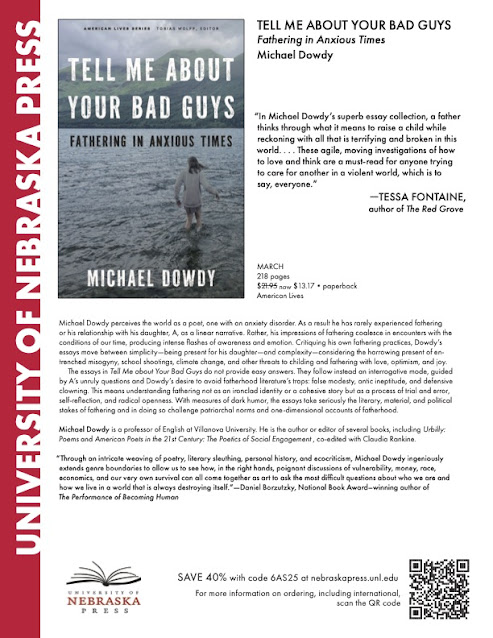
Professor Michael Dowdy publishes Tell Me About Your Bad Guys

Professor Michael Dowdy published Tell Me About Your Bad Guys: Fathering in Anxious Times. This collection of essays understands "fathering not as an ironclad identity or a cohesive story but as a process of trial and error, self-reflection, and radical openness. With measures of dark humor, the essays take seriously the literary, material, and political stakes of fathering and in doing so challenge patriarchal norms and one-dimensional accounts of fatherhood." Save 40% with the code included on the image below.

Monday, January 13, 2025

Nova English Students, Alumni, and Faculty Participate in Miltonathon

VU English faculty, students, and alumni were featured in a 24-hour global shared reading of the work of John Milton, produced by the Milton's Cottage Trust, on 8 November 2024 to commemorate the 350th anniversary of Milton’s death. Launching at Bread Street in London, where Milton was born, and culminating at St Giles Cripplegate, where he’s buried, the Miltonathon travelled to a wide range of venues with Miltonic connections and collections en route.

VU Prof. Lauren Shohet coordinated the reading of Paradise Lost book 4. You can hear English major Frankie Frabizzio '25, recent English alum Kylie Horan '25, and Professor Shohet reading from Milton's work on Youtube.


Wednesday, January 8, 2025

Professor Mary Mullen Publishes "Public Humanities, Then and Now"

 Professor Mary Mullen recently published "Public Humanities, Then and Now" in the recently launched journal, Public Humanities. The article draws on her research and builds on many discussions from her "Institutional Fictions" course. Here is the abstract:

"This essay considers how the nineteenth-century idea of the university as a refuge, constructed by thinkers like John Henry Newman, continues to shape contemporary universities and the field of public humanities. This vision of the university has lasting appeal for obvious reasons. In a culture predicated on speed, slowness is a political act. In a culture of hot takes, cold reasoning often provides necessary context, a wider view. And yet, as W. E. B. Du Bois warns, the “tenacious legend” of the Victorian university is dangerous because it separates the university from mass culture. Building on Du Bois’s thinking, the essay concludes that instead of seeking protection, enclosure, or recognition within university institutions, public humanities practitioners should seek refuge in the relationships of mutual responsibility they foster."


Tuesday, October 1, 2024

Professor Megan Quigley at the "Code Meets Culture" symposium

Pictures from Professor Megan Quigley's presentation at the "Code Meets Culture"--a symposium on the future of AI and the Future of Second Language, Literature, and Culture Pedagogy.