Welcome to the blog for the Villanova English department! Visit often for updates on department events, guest speakers, faculty and student accomplishments, and reviews and musings from professors and undergraduates alike.

Showing posts with label senior seminar. Show all posts

Wednesday, April 23, 2025

Middlemarch Mini-Conferences

Students will present research from their final projects for the senior seminar, "George Eliot's MIddlemarch" during the next three classes. Take a look at these excellent projects.


Wednesday, April 23

  • Will Corliss - “Middlemarch Reimagined: A Written Amendment of Mr. Casaubon’s Last Will and Testament”
  • Emma Cahill - “Combining Literary Worlds: Jane Austen & George Eliot, Intertwined”
  • Amanda McKean - “Media Overload and Empathic Distress: Grounding Oneself in Middlemarch’s Web” 
  • Riley Nelson - "Middlemarch and the Ordinary Life" 

Monday, April 28

  • Catherine Piergiovanni
  • Mickey Wilcox - “Middlemarch’s Unnoticed Sympathy”
  • Sam Allen - “Marriage, Feminism, and Middlemarch
  • Emily Hanlon - “'Nobody thinks Mr. Ladislaw a proper husband for you': Knowledge, Gender, and Romantic Relationships in Middlemarch"

Wednesday, April 30

  • Matthew Sabol - “Perception of and Responses to Female Morality in George Eliot’s Middlemarch
  • Will Harlan - “You Are Your Own Worst Enemy: The Tragedy of Introspection in George Eliot’s Middlemarch
  • Carlos Alvarez - “Definition, Value, & Appreciating the World Around You”
  • Mary Bondurant - “Perspectives and Misunderstandings”
  • Madeleine Brooks- “A Woven Middlemarch

Friday, May 10, 2024

Senior Seminar Research

This spring, students from the two English senior seminars, Professor Megan Quigley's "Virginia Woolf and her Daughters" and Professor Yumi Lee's "Literatures of U.S. Empire," presented their research. To look at the titles of their presentations, see the schedule for the respective symposium for "Virginia Woolf and her Daughters" here and "Literatures of U.S. Empire" here.


Monday, May 17, 2021

2021 Department Awards Ceremony

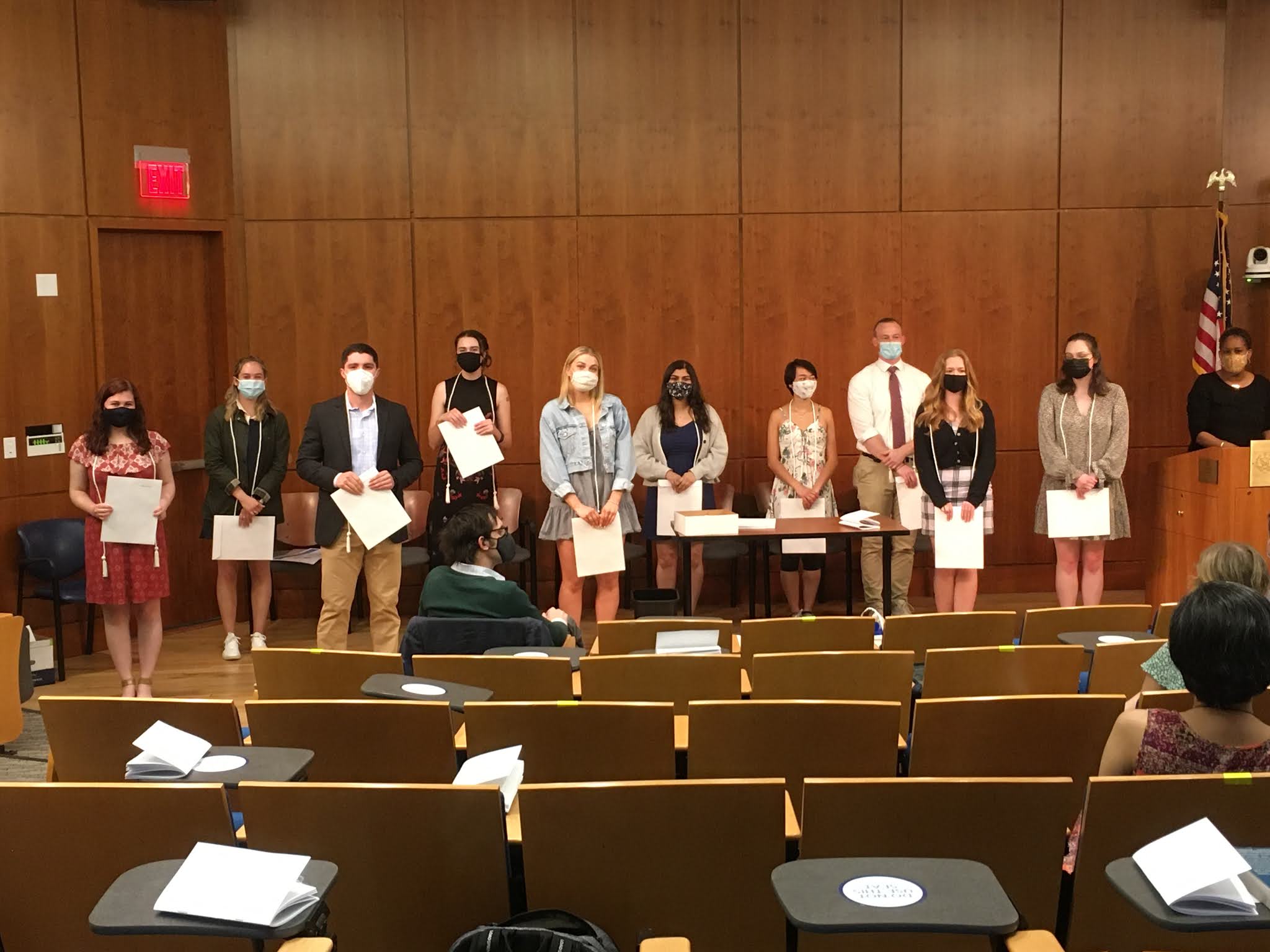
On April 30, the department held its annual awards ceremony to celebrate the members of our 2021 English Honor Society, the winners of our creative writing and essay awards, and the winner of this year's Medallion of Excellence. The event was supposed to be held in the Driscoll Tent, but high winds meant we had to move the event indoors at the last minute to the Driscoll Auditorium!

Congratulations, first of all, to the 2021 English Honor Society (see below, left to right): Amanda Atkinson, Catherine Cook, Joe D'Antonio, Erin Fabian, Julia Mills, Julia Mills, Shavani Patel, Jessie Sardina, Dom Sceski, Julia Valenti, and Jackie Solomon. Also honored, but not pictured: Jamie McClelland and Ashley Park.

The winner of this year's Core English Literature and Writing Seminar Prize, for the most distinguished scholarly or critical essay written for a Core Seminar in 2020 was Walter McDonald, for his essay, "Female Independence Challenging Social Norms" in Shirley Jackson's We Have Always Lived in the Castle. Walter's essay was written for Dr. Ruth Anolik's Spring 2020 course on "The Cultural Uses of Horror and Terror."

The judges for this award were Dr. Joe Drury and Prof. Robert O'Neil.

There were two winners for this year's Jerome J. Fischer Memorial Award, for the most distinguished scholarly or critical essays written by undergraduate students for an English course in the last year: Julia Valenti and Lily Switka. 

Julia's essay, "Austen Adaptations and the 'Accomplished Woman," was written for Dr. Joe Drury's Fall 2020 Senior Seminar on "Jane Austen Then and Now." 

Lily's essay, "Unrealistic Expectations: Miltonic Marriage and the Fall," was written for Dr. Lauren Shohet's Fall 2020 course on "Milton."

Ava Lundell also received an honorable mention for her essay, "Intimacy in Lament for Art O'Leary," written for Dr. Joseph Lennon's Fall 2020 course on "Irish Epics, Visions, and Hauntings."

The winner of this year's Margaret Esmonde Powell Memorial Award for the most distinguished essay by a graduate student written for an English course was Anne Jones. Her essay, "The Vexed Position of the Black Secret-Bearer: Concealments and Revelations in Hannah Crafts' The Bondwoman's Narrative," was written for Dr. Travis Foster's Fall 2020 course, "American Fiction Before 1900."


The judges for the Fischer and Esmonde Awards were Dr. Joe Drury, Dr. Lauren Shohet, and Dr. Brooke Hunter.

The winner of this year's George D. Murphy Award in Poetry was Madison Barber (below, second from right).

The winner of the Creative Writing Program's Award in Prose was Ashley Oh for her work, "Letter" (second from left). Pictured with them are Dr. Cathy Staples (left) and Dr. Tsering Wangmo (right).

The judges for the two creative writing awards were Dr. Alan Drew, Dr. Lisa Sewell, Dr. Adrienne Perry, and Dr. Tsering Wangmo. This year's visiting judge was the poet and educator Airea D. Matthews.

Finally, the winner of the 2021 English Medallion of Excellence was Shivani Patel, pictured with English department chair, Dr. Heather Hicks.


Congratulations, everyone!


Saturday, March 16, 2013

Greg Watry ('13) review of Sleep No More

There’s a haze to the room.  The walls and seats are covered in what looks like red velvet.  The candles on the tables appear to be the only source of light.  They cast long, dark shadows along the walls.  It’s a bar, no, more of a speakeasy.  It has an air of secrecy, a certain hushed vibe.  On the stage, a jazz quartet plays the closing bars, while a blonde beauty in a sparkling silver dress sings the finishing lyrics to “I’ve Got You Under My Skin.”  If I could best summarize my experience at Sleep No More in a statement, that song title would aptly fit.

Through my senior seminar class, "Renaissance Revenge Tragedy," I was recently given the opportunity to attend the interactive theatre extravaganza, Sleep No More.  The immersive play takes place in a five-story building in New York City, fictitiously referred to as the McKittrick Hotel.  But the play is just as much inspired by Shakespeare’s Macbeth, as it is by Hitchcock’s film Vertigo.  Patrons of the hotel are given a playing card with a specific number and led through a dark, claustrophobic hallway to the bar area, where they are encouraged to relax with a drink and ease into the experience.  Soon, groups are called by playing card number to the elevator, where they don carnival masks and are encouraged to separate from friends and family, as the play is more of “an individual experience.”


Part performance art, part haunted house, the play encourages theatre-goers to explore the various rooms of the five intricately planned floors.  At one point, I was in an insane asylum, where nurses attended to phantom patients.  At another time, I was in a foggy forest where, behind closed doors, a wooden hut hid a secret gathering of witches.  I skulked through a graveyard scene, skimmed through books, leafed through handwritten letters, examined the contents of a room dedicated to taxidermy, and even ate edible candy from the jars of a dilapidated sweet shop.  Actors entered and exited rooms at top speed, engaging one another in seductive dance.  Groups of masked patrons followed various players.  There was a storyline, it was freeform and loose, but it was there.  Regardless, each individual person comes away from Sleep No More with a unique experience.  The play encourages the audience to become the ghosts of the McKittrick Hotel.  We watch scenes of love, lust, violence, and revenge play out in front us.  The masks only further add to the experience, allowing the audience to take part in the anonymity of being a fly on the wall.

There’s no perfect way to describe Sleep No More.  To truly know, one has to experience it.  Leaving the building, I had more questions than answers.  There was more to explore, more scenes to watch unfold, more drawers and desks to sift through.  Today, I find myself thinking back on my experience.  The play—the whole experience—is an enigma, and remains stuck in my mind, like a fly in a spider’s web.  There’s a lot more to unpack with this incredibly unique adaptation of Macbeth, and I certainly plan on returning to plunge deeper into the abyss.