Welcome to the blog for the Villanova English department! Visit often for updates on department events, guest speakers, faculty and student accomplishments, and reviews and musings from professors and undergraduates alike.

Showing posts with label scholarship. Show all posts

Thursday, January 12, 2023

The Program for Public Thinking: Summer Program

 The Summer Workshop provides a space for undergraduate students interested in journalism, criticism, politics, art, and nonprofit work to learn about and practice engaging the public through dialogue and writing. The theme of this year’s workshop is “the future,” and its central questions are: How do we think about the future, especially when we cannot trust that it will be better than the present? What do we owe future generations? Students will learn to address such questions in conversation with various philosophical, political, and religious traditions, as well as with one another. For their final assignment, they will design a public-facing project to foster dialogue on their own college campuses. The inaugural workshop will be taught by Point editors Jon Baskin and Anastasia Berg.


Monday, May 17, 2021

Just Published! Dr. Jean Lutes on Alice Dunbar-Nelson's "His Heart's Desire"

Congratulations to Dr. Jean Lutes, whose article, "A Queer Tale of Two Endings: Alice Dunbar-Nelson and 'His Heart's Desire,'" was just published in J19, a scholarly journal for nineteenth-century Americanists.

Combining archival research with childhood and Queer studies, Dr. Lutes's essay analyzes multiple versions of "His Heart's Desire," an extraordinary but little-known short story by Alice Dunbar-Nelson about a racially unmarked boy who wants a blonde, blue-eyed doll. While the story was originally meant to be part of a never-finished story collection, it has seen print separately in two different versions, one published during Dunbar-Nelson's lifetime and one posthumously. In this essay, Dr. Lutes argue that the story's two published versions, when read together, make a devastating case for the damage wrought by global imperialism and its fetishizing of white femininity. Dr. Lutes's comparative textual study also indicates Dunbar-Nelson may have engaged in savvy self-censorship that ultimately contributed to her relative obscurity in the current day, even among scholars of African American studies and Queer studies.

Be sure to check out Dr. Lutes's acknowledgments, which names the team of six students, undergraduate and graduate, who helped her with this project: Gia Beaton, Michael DeAngelo, John Flynn, Lucy Mileto, Elena Patton, and Jackie Solomon.


2021 Department Awards Ceremony

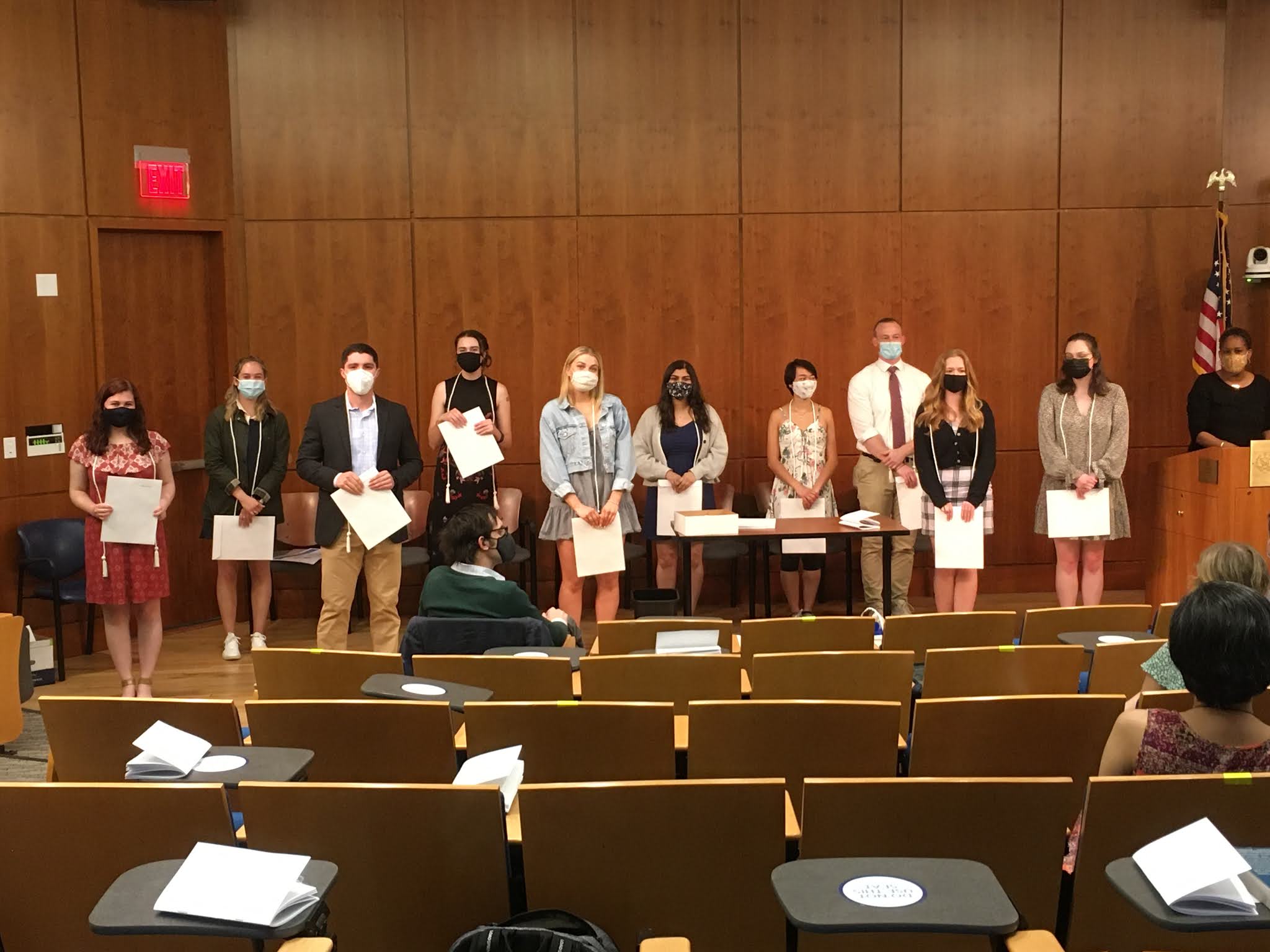
On April 30, the department held its annual awards ceremony to celebrate the members of our 2021 English Honor Society, the winners of our creative writing and essay awards, and the winner of this year's Medallion of Excellence. The event was supposed to be held in the Driscoll Tent, but high winds meant we had to move the event indoors at the last minute to the Driscoll Auditorium!

Congratulations, first of all, to the 2021 English Honor Society (see below, left to right): Amanda Atkinson, Catherine Cook, Joe D'Antonio, Erin Fabian, Julia Mills, Julia Mills, Shavani Patel, Jessie Sardina, Dom Sceski, Julia Valenti, and Jackie Solomon. Also honored, but not pictured: Jamie McClelland and Ashley Park.

The winner of this year's Core English Literature and Writing Seminar Prize, for the most distinguished scholarly or critical essay written for a Core Seminar in 2020 was Walter McDonald, for his essay, "Female Independence Challenging Social Norms" in Shirley Jackson's We Have Always Lived in the Castle. Walter's essay was written for Dr. Ruth Anolik's Spring 2020 course on "The Cultural Uses of Horror and Terror."

The judges for this award were Dr. Joe Drury and Prof. Robert O'Neil.

There were two winners for this year's Jerome J. Fischer Memorial Award, for the most distinguished scholarly or critical essays written by undergraduate students for an English course in the last year: Julia Valenti and Lily Switka. 

Julia's essay, "Austen Adaptations and the 'Accomplished Woman," was written for Dr. Joe Drury's Fall 2020 Senior Seminar on "Jane Austen Then and Now." 

Lily's essay, "Unrealistic Expectations: Miltonic Marriage and the Fall," was written for Dr. Lauren Shohet's Fall 2020 course on "Milton."

Ava Lundell also received an honorable mention for her essay, "Intimacy in Lament for Art O'Leary," written for Dr. Joseph Lennon's Fall 2020 course on "Irish Epics, Visions, and Hauntings."

The winner of this year's Margaret Esmonde Powell Memorial Award for the most distinguished essay by a graduate student written for an English course was Anne Jones. Her essay, "The Vexed Position of the Black Secret-Bearer: Concealments and Revelations in Hannah Crafts' The Bondwoman's Narrative," was written for Dr. Travis Foster's Fall 2020 course, "American Fiction Before 1900."


The judges for the Fischer and Esmonde Awards were Dr. Joe Drury, Dr. Lauren Shohet, and Dr. Brooke Hunter.

The winner of this year's George D. Murphy Award in Poetry was Madison Barber (below, second from right).

The winner of the Creative Writing Program's Award in Prose was Ashley Oh for her work, "Letter" (second from left). Pictured with them are Dr. Cathy Staples (left) and Dr. Tsering Wangmo (right).

The judges for the two creative writing awards were Dr. Alan Drew, Dr. Lisa Sewell, Dr. Adrienne Perry, and Dr. Tsering Wangmo. This year's visiting judge was the poet and educator Airea D. Matthews.

Finally, the winner of the 2021 English Medallion of Excellence was Shivani Patel, pictured with English department chair, Dr. Heather Hicks.


Congratulations, everyone!


Wednesday, March 17, 2021

Dr. Megan Quigley Discusses T. S. Eliot and what Scholars are Learning from the Recently Unsealed Hale Archive

Listen to Dr. Megan Quigley, as she joins T. S. Eliot experts Frances Dickey and John Whittier-Ferguson on a podcast to discuss the revelations of the Hale archive: 1, 131 letters written by T. S. Eliot to his longtime love and correspondent, Emily Hale (pictured below). The letters, called the most famous sealed literary archive in the world, were under lock and key at Princeton’s Firestone library until 50 years after the deaths of Eliot and Hale.

Their contents have transformed what scholars thought they knew about Eliot, as he points out his sources, undermines key ways we interpret his works—such as Modernist impersonality—and confesses his dreams and goals. And then he burns her side of the correspondence!

Matt Seybold is the host on this episode of the American Vandal podcast.


Tuesday, March 16, 2021

A Conversation with Merve Emre -- March 23

 Please join Dr. Megan Quigley and Dr. Kamran Javadizadeh for a conversation with Merve Emre, associate professor of English at the University of Oxford, author of The Personality Brokers: The Strange History of Myers-Briggs and the Birth of Personality Testing (2018) and Paraliterary: The Making of Bad Readers in Postwar America (2017), and editor of a new annotated edition of Virginia Woolf's Mrs. Dalloway

The event will take place on Zoom at 4pm on Tuesday, March 23. Please register here to receive the link.


Sunday, March 7, 2021

Dr. Jean Lutes and Dr. Travis Foster Discuss Gender, American Literature and White Supremacy

Please join Villanova English faculty Dr. Jean Lutes and Dr. Travis Foster on Tuesday, March 16 for "We Have Been Here All Along: Gender, American Literature, and White Supremacy," an event to celebrate the publication of a new collection of essays on Gender in American Literature and Culture. The volume, co-edited by Dr. Lutes, will be published this month by Cambridge University Press and features essays by Dr. Lutes and Dr. Foster.

The book introduces readers to key developments in gender studies and American literary criticism. It offers nuanced readings of literary conventions and genres from early American writings to the present and moves beyond inflexible categories of masculinity and femininity that have reinforced misleading assumptions about public and private spaces, domesticity, individualism, and community. The book also demonstrates how rigid inscriptions of gender have perpetuated a legacy of violence and exclusion in the United States. Responding to a sense of 21st century cultural and political crisis, it illuminates the literary histories and cultural imaginaries that have set the stage for urgent contemporary debates.

Also speaking at the event will be Dr. Lutes's co-editor, Dr. Jennifer Travis, professor and chair of English at St. John's University, as well as two contributors to the volume: Dr. Brigitte Fielder, associate professor of English at the University of Wisconsin-Madison, and Dr. Seulghee Lee, assistant professor of African American and English literature at the University of South Caroline.

The event will be held on Zoom, starting at 7.30pm. You can register here.


Sunday, February 7, 2021

Dr. Jean Lutes to Speak on White Supremacist Violence and the Assault on the US Capitol -- February 18

Please join Villanova English professor Dr. Jean Lutes for an event on the January 6 assault on the Capitol and the history of white supremacist violence in the US. 

Dr. Lutes will be joined by Robert M. Birmingham Chair in the Humanities Judy Giesberg for a discussion of recent political events, history, racism, and democracy. This ACS-approved event will be held on Zoom Thursday, February 18 from 7:00 – 8:00 p.m, and is sponsored by the departments of History and English. You can register here. 


Friday, October 9, 2020

Register for Annual Luckow Family Lecture: Rob Nixon, October 27

Please join Villanova English this month for the department's annual Luckow Family Lecture. Rob Nixon, Barron Family Professor of Humanities and Environment at Princeton University, will be joining us by Zoom on Tuesday, October 27 at 5.30pm, to present a talk, "The Less Selfish Gene: Forest Altrusim, Neoliberalism, and the Tree of Life." 

Please register here to receive the Zoom link for the event.


Wednesday, December 5, 2018

Dr. Lauren Shohet publishes article on Milton and Frankenstein

Dr. Shohet's article, "Reading Milton in Mary Shelley's Frankenstein," was just published in Milton Studies 60 (2018).


Dr. Shohet's essay suggests that Frankenstein engages Paradise Lost with more consistency and nuance than critics have previously acknowledged. Rather than a straightforwardly agonistic response, the novel instead classifies different kinds of Miltonic readers through its characters: the Milton-literate Creature, the Milton-oblivious Robert Walton, and the aware but studiously avoidant Victor Frankenstein. Redistributing labor from Milton’s Adam, Eve, Satan, and Father to Frankenstein’s various characters, Dr. Shohet argues, the novel raises questions about the world of its characters and of Milton’s epic. Practicing both adaptation and critique, Frankenstein dissents from some other Romantic responses to prove surprisingly sympathetic to aspects of Milton’s Reformist ethos.

Thursday, September 29, 2016

Prof. Hugh Ormsby-Lennon: Fools of Fiction: Reading William Trevor's Stories

The Kindle edition of English department professor Hugh Ormsby-Lennon and Margaret Boerner's study of renowned Irish writer William Trevor, Fools of Fiction: Reading William Trevor's Stories, is available here.  The authors, in the words of Maureen O’Connor of University College Cork, "provide a fresh assessment of William Trevor, one of the greatest short-story writers Ireland has produced."  Because of Fools of Fiction, says O'Connor, "New readers will rush to discover the stories, while those familiar with Trevor will return to them with renewed enthusiasm."


Friday, January 8, 2016

Dr. Crystal Lucky's edition of A Mysterious Life and Calling

Crystal Lucky lived up to her name when she found a forgotten autobiography of a former slave in the library archives at Wilberforce University in Ohio. Lucky, an associate professor of English and the director of the Africana Studies Program at Villanova, is also an ordained elder, church official, and pastor’s wife. So, she was thrilled and astonished to discover the unknown memoir of an African American woman who was a licensed minister and popular preacher in the Carolinas after emancipation from slavery.

Reverend Mrs. Charlotte Levy Riley had called her book A Mysterious Life and Calling. As Lucky began to read it, she knew that she had found something—and someone—extraordinary. Lucky has now published Riley’s memoir with the University of Wisconsin Press, providing an introduction and notes on events, society, and religious practice in the periods before, during, and after the Civil War and Reconstruction, and placing Riley’s story in the context of other spiritual autobiographies and slave narratives.

Born into slavery in 1839 in Charleston, South Carolina, young Charlotte Levy was taught to read, write, and sew despite laws forbidding black literacy. Raised a Presbyterian, she wrote of her conversion at age fourteen to the African Methodist Episcopal (AME) church, embracing its ecstatic worship and led by her own spiritual visions.

Riley’s memoir is a revelation on many counts, including life in urban Charleston before and after emancipation, her work as a preacher at multiracial revivals, the rise of African American civil servants in the Reconstruction era, and her education and development as the only woman preacher in South Carolina. She was a licensed female minister in a patriarchal church, a feat rarely achieved at that time by women anywhere in the country, whether black or white. She also became a teacher of newly emancipated black people and their children, and postmistress of Lincolnville, an all-black incorporated town outside of Charleston where she owned a home and spent most of her adult life.

Riley published her memoir privately in the early twentieth century, but as of yet Lucky has not discovered the year of its publication. “What is clear,” Lucky says, “is that the events span the nineteenth century and the earliest years of the twentieth. Charlotte was born to enslaved parents, John and Sarah Levy, in Charleston on August 26, 1839.”

From the book:
"As an enslaved girl in one of the busiest cities in the antebellum South, young Charlotte was spared some of the physical hardships of chattel slavery. She even received a modest education at a school run by a local widow, where she learned to read, write, sew, and do basic math. Her mother died when she was very young, so an uncle and a grandmother helped to raise her. Eventually, she began to live with and serve her grandmother’s white mistress, which closely aligned her with affluent, white Charlestonians. At the close of the Civil War, Charlotte married a free black architect, was shortly thereafter abandoned by her husband, began to worship and work with the A.M.E. Church, taught in a church-sponsored school, and received her local preacher’s license in 1871, just one year after African American men obtained the right to vote. She really is quite remarkable.”

As the Reverend Charlotte S. Riley, the newly freed woman worked tirelessly to position African American men, women, and children to benefit economically, educationally, and spiritually from the vast changes that were happening throughout the United States as a result of Emancipation. She taught basic literacy skills and Bible classes to children and adults and traveled hundreds of miles to preach, despite debilitating health problems. In her travels, she also began to assist African American communities and mentor leaders in resisting the backlash of racial violence and the rise of Jim Crow laws. She took a role in organizing sharecroppers, assisting the newly formed Colored National Labor Union, and aiding the Honorable Robert Brown Elliott, the first African American commanding general of the South Carolina National Guard.

Although a memoir like Riley’s is quite rare, Lucky points out, “The power of narrative was important for women, whose physical presence was consistently scrutinized. Riley was aware of her tenuous public position; she repeatedly refers to herself in her autobiography as a ‘woman preacher’ rather than as a preacher or minister.” For some, her existence posed problems. “She faced skepticism from whites and blacks about whether a ‘real woman’ could be a preacher and, in turn, whether a preacher could really be a woman.”
Dr. Crystal Lucky
A few accounts by nineteenth-century black preaching women in the northern states are known, but this is the first discovery of such a memoir written in the American South. Herman Beaver, professor at the University of Pennsylvania, notes, “This edition will be in people’s hands for a very long time. A Mysterious Life and Calling is a valuable primary source that can be referenced and studied in so many literary and cultural contexts.”

Publishers Weekly notes that “Lucky has truly uncovered a gem with this autobiography of Charlotte S. Riley. . . An important, informative achievement."  The Southern Independent Booksellers Association (SIBA) has also chosen A Mysterious Life and Calling as one of only 13 books being  recommended to Southern bookstores as an “Okra Pick” (a Southern version of Oprah Picks) for the spring season.

Thursday, April 16, 2015

Carrie Teresa Wins Blanchard Dissertation Prize

The American Journalism Historians Association has selected former Villanova English major Carrie Teresa as the winner of the 2015 Margaret A. Blanchard Doctoral Dissertation Prize.

Teresa, an assistant professor at Niagara University, won the award for her dissertation titled, “Looking at the Stars: The Black Press, African American Celebrity Culture, and Critical Citizenship in Early Twentieth Century America, 1895-1935.”  This study examined how African American journalists and editors writing at the height of Jim Crow-ism covered celebrity culture and how this coverage was connected to the fight for civil rights.

Teresa will receive $500 and a plaque during the 2015 AJHA national convention in Oklahoma City in October.

Carrie Teresa

Tuesday, September 9, 2014

Prof. Lutes and Nelly Bly

Radio station WHYY (90.9 FM) will be interviewing Prof. Jean Lutes about her edition of Nelly Bly this Wednesday, Sept. 10, at 7:30 am.  The interview may be linked to a Philadelphia Fringe festival show about Nellie Bly, Nellie/Nellie, a music-driven dance theater exploration of Bly's Ten Days in a Mad-House.  Nellie/Nellie is playing this Thursday through Saturday  at 8:00 pm at the Broad Street Ministry (in their big historic sanctuary in Center City). Tickets are free and you can click here to reserve them.

You can also click here to listen to Prof. Lutes' July 4 discussion of Nelly Bly on the WBEZ "Nerdette Podcast"--the Great Lady Nerds of American History special.


Monday, November 25, 2013

Dr. Charles Cherry Essay

Dr. Charles Cherry’s essay “Quakers and Asylum Reform” has just been published in The Oxford Handbook of Quaker Studies, edited by Stephen W. Angell and Pink Dandelion for Oxford University Press.  After placing asylum reform in the context of Quaker beliefs and history in 17th century England, Dr. Cherry’s article discusses the central role of England’s York Retreat, established in 1796.  It provided a model of kindness and compassion, known as “moral treatment,” that influenced the growth of numerous imitators in England and America and became a positive counterpoint to the questionable treatments at private madhouses and public hospitals.  This concept has been revived in the 20th century under such new rubrics as “milieu therapy” and the “open hospital.”

Saturday, April 13, 2013

Prof. Megan Quigley: Adventures in the Archive

Megan Quigley, an assistant professor in the English department, is on sabbatical 2012-13.  She is working on several projects, including a book manuscript, Modernist Fiction and Vagueness, and an article on Wallace Stevens, analytic philosophy, and the alphabet.  Prof. Quigley will be teaching a class on the modern British novel this fall.

From Prof. Quigley:
I always get in trouble in the archives.  Maybe this is slightly paranoid, but whenever I’m doing archival research, looking through an author’s manuscripts, correspondence, and personal library at a rare book’s library, I can feel the eyes on me.  For a while, I’m good.  I diligently look through correspondence, take fastidious notes, photograph only when and where I’m directed.  But then, then my appetite grows.  My curiosity soars.  I am elated, inexhaustible.  I am suddenly in 1927 evaluating Vanessa Bell’s cover drawing for the first edition of her sister’s To The Lighthouse; or I’m holding Wyndham Lewis’s drawings in my hand, wondering when and why Ezra Pound looked like that; or it’s 1950 and I’m reading a letter, not collected in Wallace Stevens’s published letters, where he’s told that on the night the eminent critic F. O. Matthiessen committed suicide, the only topic that brought light to his eyes was discussing Stevens’s poems.  How did Stevens feel when he read this?  What can the handwriting show me?  What does that double underline mean?

Then I begin to push the limits.  I stop making eye contact with the kind librarians behind the desk as I drop off my manuscript call slips.  My materials grow and I persevere.  The bell that rings at 11:45 seems earlier and earlier.  I hurry to drop off slips before everyone heads to lunch.  I’m sure I need to see Henry James’s letters too.  And W. H. Auden—his drafts are here too?  I find non-rare books that I’m allowed to keep at lunchtime when the room is empty and quiet.   I chug my bottle of water near the lockers (I’m not sure that I’m not allowed any liquids in the building) and hurry back to my assigned desk.


Later, when a door from an inner sanctum opens behind the counter, I think myself invisible.  I am absorbed in the first edition of Eliot’s Poems in front of me, the woven blue Hogarth cover at odds with the harsh lines within.

“Miss Quigley?”
I can’t pretend I don’t see the figure next to me anymore.
“Yes?”
“Can you come talk to me up in my office?”
I visualize myself as a wise old man in a three-piece suit, with thick glasses, a purposeful, heavy step, and thinning white hair, as I walk up the stairs.
“Miss Quigley, you seem to be ordering up a lot of Wallace Stevens personal library, is this correct?”
“Yes.”  (I’m glad I didn’t ask to see the Gutenberg bible or that first edition of Goethe.)
“Do you need to see his first edition of Ulysses?”  The voice is friendly so I venture to look over from the bookcase where I’ve been staring.
“Yes, well, you see, yes.  I think there’s a chance that Stevens took notes in it, so you see, yes, I really thought it best if I see it.”
“And how many more books from Stevens’s library do you intend to call up?”
“Well, actually, you see, um, I’ve really just gotten started.  I have several more call slips filled out already.” (Actually I have forty-three more, I filled them out in my hotel room last night.)
“Why don’t you come with me?”

As we exit through a small back door in his office into a dark corridor, I wonder if my fellowship is about to be revoked.  It smells like an old school gymnasium back here.  We take a small elevator down, down, down and enter a vault, after he swipes his security card several times.  In the vault we are briefly in total darkness.  He’s not actually going to kill me?

“Oh dear,” he exclaims, “Let me just get the switch, it’s over here.”
The sudden brightness reveals a kind of bibliophile’s heaven.  Stack upon stack, row upon row, of rare books.  Jane Austen, in twenty different early versions?
“Dude!” I shout.  (Seriously, that’s what I said.)
 I briefly lose my guide as he heads rapidly over to the Stevens section.
“Here,” he says.  He is pointing to several shelves.  “It’s much easier for us if you find what you need and call it up all I once.”
I nod eagerly.
“Oh, and much of this is actually not catalogued yet, from a recent library purchase, so you might find something here you didn’t know you wanted.  You can have about ten minutes here, then I have a lunch meeting.”
New, uncatalogued, books from Stevens’s library?
We smile at each other.  And I get back to work.

Prof. Megan Quigley and daughter at the Huntington.


Wednesday, April 10, 2013

Peter Naccarato: Culinary Capital

Former Villanova English major Peter Naccarato, now Professor of English and Chair of the Humanities division at Marymount Manhattan College, has recently published (with Kathleen LeBesco), Culinary Capital.


TV cookery shows hosted by celebrity chefs. Meal prep kitchens. Online grocers and restaurant review sites. Competitive eating contests, carnivals and fairs, and junk food websites and blogs. What do all of them have in common? According to Naccarato and LeBesco, they serve as productive sites for understanding the role of culinary capital in shaping individual and group identities in contemporary culture.  Beyond providing sustenance, food and food practices play an important social role, offering status to individuals who conform to their culture's culinary norms and expectations while also providing a means of resisting them. Culinary Capital analyzes this phenomenon in action across the landscape of contemporary culture. The authors examine how each of the sites listed above promises viewers and consumers status through the acquisition of culinary capital and, as they do so, intersect with a range of cultural values and ideologies, particularly those of gender and economic class.

Wednesday, February 13, 2013

2013 Kalas Award Applications

The Philadelphia Broadcasters Foundation is pleased to announce that the application period for the 2013 Kalas Award is now open.

The Kalas Award is given annually to a deserving college student(s) who has a stated desire and has shown initiative towards a career in sports broadcasting. The award was created in 2009 to honor the life and work of the late Philadelphia Phillies broadcaster Harry Kalas.

To be eligible for the award, students must have completed their sophomore year of post-secondary education at one of the eligible colleges and universities in the Philadelphia region. Current sophomores who will complete the coursework at the conclusion of the spring 2013 semester will also be eligible for the award.

The Philadelphia Broadcasters Foundation will award a minimum of one scholarship grant of $1,500, payable for the 2013 fall semester.  Additional scholarships may be granted at the discretion of the Foundation.

Application submissions are due no later than April 30, 2013.  Applications are available here.


Saturday, January 5, 2013

New York Women In Communications Scholarship

If you are female, reside in Connecticut, New York, New Jersey, or Pennsylvania, and have a cumulative GPA of 3.2, you may wish to apply for a New York Women in Communications scholarship.  One Villanova English major has already won a scholarship--Nkiruka Umegbolu, who was also awarded a full-time, paid internship in New York City. (Thanks to Nkiruka for bringing this scholarship to our attention.)


For more information about New York Women in Communications, click here.